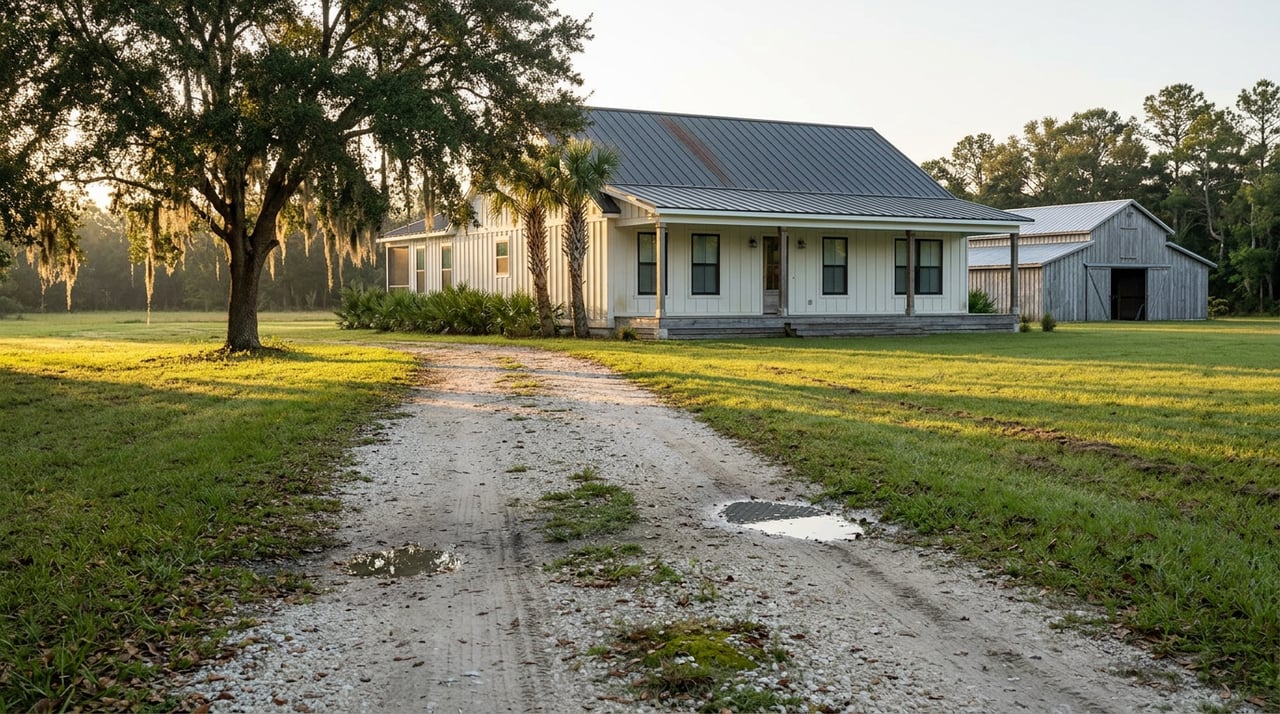
There is a farmhouse in Myakka City that has been sitting for a while. Built in 1941 by Clint and Eva Hutches, both former Manatee County sheriffs, the original log home sat on 8 acres of rural land east of the coastal corridor before being fully restored by French designer Gaëlle Wizenberg. It is the kind of property that would move fast in a subdivision. Out here, it waits.
If that same listing sat unsold for three-plus months in a Lakewood Ranch neighborhood, most buyers would assume something was wrong with it. Overpriced. A bad inspection everyone's heard about. A seller who won't budge. In Myakka City, a long timeline usually means none of those things. It means the property is doing exactly what rural Florida acreage does.
That distinction matters if you're comparing Myakka City to a master-planned community and trying to figure out what the numbers actually tell you.
The Number That Looks Like a Red Flag
Track Myakka City's average days on market through 2026 and it looks like a market losing steam. A market analysis published in mid-July 2026 put the figure at 95 to 114 days, already well above what buyers see in nearby suburban markets. By late July, one snapshot of active listings showed an average of 125 days on market. By early August, another showed 144 days.
Read that as a trend line and you'd conclude the market is cooling fast. Read it as a structural feature of rural transactions and a different picture appears. These are small samples, sometimes fewer than 40 active listings at a time, so a handful of large-acreage estates sitting longer can pull the average up without reflecting anything about overall demand. The number moves because the market is thin, not because it's weakening.
Why the Clock Runs Longer Out Here
A subdivision closing moves fast because the due diligence is standardized. City water, city sewer, a title search, an appraisal against a dozen comparable sales within a half mile. None of that applies the same way on a Myakka City parcel.
Buyers here are typically working through:
- Well water testing and capacity
- Septic system inspection and permitting history
- Agricultural exemption status and whether it transfers or resets
- Easements, especially on parcels that border working ranches or have shared access roads
- Flood zone verification, since elevation varies more across large lots than it does within a platted community
Each of those takes time to do properly, and rushing any of them is how buyers end up with surprises after closing. A 40-acre parcel with a barn and cross-fenced pasture simply requires more verification than a 2,200-square-foot home on a quarter acre. The extended timeline isn't the market failing to clear. It's the market doing the work a subdivision transaction skips.
The Gap Between What Sellers Ask and What Buyers Pay
Here is where the numbers get interesting. Median list prices reported across 2026 snapshots have run high, from around $950,000 in June up to $1.14 million by early August. But the median sale price for homes that actually closed over the trailing 12 months has been reported closer to $675,000, and a separate mid-2026 market analysis put typical sale prices in the area at $600,000 to $700,000.
That gap between what's listed and what closes is wider than what you'd see in Lakewood Ranch or Parrish, where new construction sets a fairly hard price floor and comparable sales cluster tightly. In Myakka City, the spread is the leverage. It tells you sellers are testing the top of the market with asking prices, and buyers who do their homework have real room to negotiate on price, terms, or repair credits, especially the longer a property has been sitting.
Three Markets Wearing One Zip Code
Myakka City isn't one market. It's three, stacked by acreage, and treating them as a single number flattens the picture buyers actually need.
| Tier | Typical Acreage | What's On It | Market Behavior |
|---|---|---|---|
| Entry rural | 2–10 acres | Older construction or manufactured homes, no HOA | Fastest-moving tier, most accessible price point |
| Core equestrian | 10–40 acres | 1,500–3,500 sq ft home, 2–6 stall barns, cross-fenced pastures | The heart of the horse-property market |
| Large estate | 50–300+ acres | Working ranches, cattle operations, custom estates, ponds | Often 200+ days on market, smallest buyer pool |
A buyer shopping the entry tier is playing a completely different game than a buyer shopping a working cattle operation. Lumping them into one average days-on-market figure is part of why the topline number looks scarier than the reality on the ground for any single price band.
The Missing Builder
Drive through Lakewood Ranch or Parrish and new construction is everywhere, with builders offering rate buydowns and design-upgrade incentives that put constant downward pressure on what resale sellers can ask. Myakka City has none of that. There is no builder inventory competing with existing listings.
That absence cuts in a direction buyers often don't expect. It means Myakka City sellers aren't getting undercut by a subdivision going up next door, so resale pricing holds up better against the kind of new-construction competition that squeezes sellers elsewhere in Manatee County. But it also means buyers here don't get the leverage that comes from pointing at a builder's incentive package down the street. The negotiating room in this market comes almost entirely from patience and from being the buyer who's actually ready to close once due diligence wraps, not from having a cheaper new-build alternative to walk toward.
A property that sits for 100 days in a subdivision is usually telling you something is wrong. A property that sits for 100 days in Myakka City is often just waiting for a buyer who's willing to do the work.
What Your Money Actually Buys
Price per square foot is the wrong tool here, and the average sale price of active land alone makes the case. Land in the area has been trading around $53,832 per acre, which means the improvements on a parcel, the house, barns, fencing, and well, are almost a separate calculation layered on top of raw land value. A 1,200-square-foot home on 6 acres and a 3,000-square-foot home on 6 acres can carry a similar total price once you account for the land underneath both.
That framing matters most when comparing Myakka City to Lakewood Ranch. A buyer priced out of any detached home in Lakewood Ranch can, in Myakka City, find 5 to 40 acres with a barn and no HOA, with some listings advertised as roughly 20 minutes from Lakewood Ranch's in-town amenities. It's not a like-for-like comparison on square footage. It's a different asset entirely, one where the acreage itself is doing a lot of the price work.
The Place Underneath the Numbers
None of this happens in a vacuum. Myakka River State Park, one of Florida's largest, borders the community to the west, which is part of why large-acreage land here stays scarce rather than getting subdivided into the next phase of rooftops. A few miles south, the well-known Terranova Equestrian Ranch sits alongside the kind of large land tracts that still trade hands in this corridor, and communities like Magnolia Hill and Lakeside Ranch, where homesites run a minimum of five acres, show what the core equestrian tier actually looks like on the ground.
For day-to-day life, residents point to the Myakka City Flea Market, the Myakka City Arts Center, and Myakka Community Park as the low-key gathering points in a place that isn't built around a downtown. Family attractions like Myakka Elephant Ranch and Bearadise Ranch round out the area's working-land character. None of that shows up in a days-on-market chart, but it's the reason buyers who want space keep choosing this corner of Manatee County over a subdivision closer to the coast.
A Few Questions Worth Settling Before You Look
Does no HOA mean no rules at all? No. Confirming what's recorded against a property is still part of due diligence, HOA or not.
Is a long time on market always a reason to offer low? Not automatically. A 6-acre entry-tier property sitting 150 days might be overpriced. A 120-acre ranch sitting 220 days might just be waiting for the small pool of buyers who want that much land to find it. The tier tells you more than the raw number does.
The 100-day listing isn't the exception in Myakka City. It fits the longer timelines described above. Buyers who understand why tend to move through this market with more confidence and less anxiety about a number that would mean something entirely different anywhere else in the county.
If you're weighing Myakka City acreage against a home in Lakewood Ranch or Parrish and want help reading what a specific listing's timeline actually signals, The Paxton Group can walk through the comparison with you. Start your Florida lifestyle search and let's figure out which market actually fits what you're trying to buy.
This article is general information, not legal, tax or financial advice. Consult a qualified professional about your situation.